
If you are wondering what to do in your lunch break on Wednesday, then a good idea is to brew a cup of tea, make a sandwich and watch the Budget.
It is the biggest single event of the year affecting your finances.
In his speech, the chancellor will announce the government's plans for tax and spending.
No major changes to income tax and National Insurance are expected, but more is expected about the government's plans for the housing market.
Here is your essential guide.
When is the Budget?
It is on Wednesday, 22 November, at about 12:30 GMT.
Prime Minister Theresa May gets her weekly grilling from MPs in Prime Minister's Questions in the Commons at 12:00. When that is finished, she will sit down and the chancellor will deliver his Budget speech.
It usually lasts about an hour, although the longest continuous Budget speech was by William Gladstone in 1853, lasting four hours and 45 minutes.
Labour leader Jeremy Corbyn then gets the first response, before MPs debate the Budget.
Who is the Chancellor, Philip Hammond?
Arguably, the second most powerful person in government, behind the Prime Minister.
He was appointed as chancellor - known in many countries as the finance minister - in July 2016.
Image copyright
PA
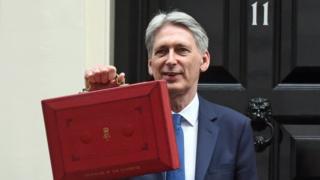
Philip Hammond (right) has not got much spare cash (left) to spend
Mr Hammond entered Parliament at the relatively late age of 41 as a millionaire. He has been the Conservative MP for Runnymede and Weybridge since 1997.
He has been dubbed "Spreadsheet Phil" owing to his love of numbers, including running over finances while on the beach on holiday.
Why is everyone talking about housing this time?
Governments nowadays tend to announce some of the content of the Budget in the days leading up to the speech, whereas it used to be a closely guarded secret.
Among the announcements so far this time have been two on housing - one on a change to the rules to encourage more social housing, and another from the chancellor suggesting measures to see thousands more homes being built each year.
There has also been widespread speculation that the chancellor might do something to change stamp duty in England - a tax levied on buyers - to ease the burden for first-time buyers. Scotland already has its own system and Wales has its own from April 2018.
It is worth remembering that stamp duty is by no means the biggest up-front cost for buyers. The average deposit outside London is £24,000 and in London it is £72,000.
Estate agent Savills estimates that the average stamp duty bill for first-time buyers is about £2,700.
What else might be included?
First of all, Mr Hammond will set out the state of the nation's finances before he gets into more individual measures.
One thing he might have to address is productivity, or lack of it. This is the amount we make per worker, per hour - in other words how efficient each worker is. Raising productivity is crucial to boosting economic growth in the UK and increasing wages.
We know that the chancellor will talk about investment in driverless cars - he has told us that already.
Staying with transport, he is expected to extend railcards offering discounted train travel to people up to 30 years old.
Currently, the young persons' railcard is for the 16-25 age bracket, but a new 26-30 card will be introduced.
Pay day?
What many will be watching very closely is whether he announces any change to two key planks of austerity - public sector pay and benefit levels.
Many working-age benefits are nearly halfway through a four-year freeze. These include Jobseeker's Allowance, Employment and Support Allowance, some types of Housing Benefit, and Child Benefit.
The cap on public sector pay rises in England and Wales has been in place in some form since 2010.
- Budget 2017: What we know already
The real detail on all of these plans, and how much they will cost or save, is in the Budget red book - a fat document published as soon as the chancellor has sat down after his speech.
Will I be paying more for a pint?
Apart from the fact that he is permitted to drink alcohol during the speech (although the last chancellor to actually do so was Kenneth Clarke with a whisky), he sets the so-called "sin taxes" on cigarettes and booze.
So, at the end of the day on Wednesday, any change in these duties will come into effect and is likely to have an immediate impact on prices.
For example, beer duty was increased by 2p a pint in the last Budget.
- Pubs urge Hammond to cut beer duty
When is the next Budget?
At about the same time next year.
If you cannot wait that long, then there is the spring statement in late February or early March, which updates the state of the nation's finances.
Many powers, as well as some tax issues, are devolved to the nations of the UK. Expect more on those in the coming weeks.
One big announcement will be the Scottish government's intentions for the higher rate of income tax, to be outlined in December.
