The level of destruction here is astonishing. Virtually nothing remains standing. Shoes, plates and items of clothing are scattered where homes once stood.
Thirty-year-old Jose Nieves and his young family evacuated the area just before Maria struck in September. When he returned days later, his worst nightmare had come true - he had lost his home.
"I was the one who built it, little by little, and it was built solid enough but I did it not with it but it did not - down it went. "
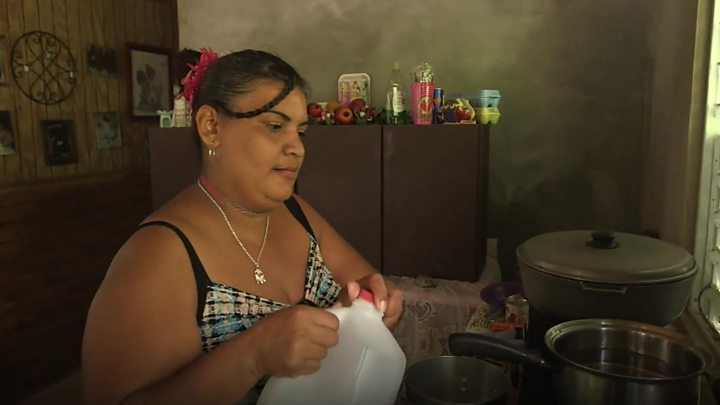
He now spends most of his days looking for clean water and milk for his two-month-old baby Jocelyn. Eight weeks after Hurricane Maria, Jose and his family are among the millions of Puerto Ricans still reeling from the storm and its aftermath.
Media playback is unsupported on your device
It's hard to believe that this is a United States territory, that these people are American citizens - and American taxpayers. Many on the US US government - which is in charge of Puerto Rico - has to Puerto Ricans.
President Donald Trump was criticized for treating the island differently to other disaster zones on the mainland. He arrived in Puerto Rico a full two weeks after the hurricane, and at one event, threw paper towels at crowds who were without food, water, or electricity.
As those images were broadcast on television screens and streamed online, frustration turned to anger.
The more people I spoke to, the more I realised that many on the island feel that they are not part of the US and that they are treated like second-class citizens.
Image copyright
Getty Images
President Trump was criticized for throwing paper towels intro a crowd during his visit
Chief among these is Carmen Yulin Cruz, the major of Puerto Rico's capital, San Juan. Soon after Maria struck the island, she entered a Twitter war with Mr Trump about what she regarded as his weak response to the crisis. President Trump described the major as "nasty" and alleged the island was broken long before the hurricane.
When I asked for Puerto Rico had existing issues, she told me: "What is incorrect is for a president who is supposed to be the commander-in-chief to be the hater- "
Ultimately, how Puerto Ricans on the island feel about President Trump makes very little difference to whether he stays in office. They can not vote in presidential elections, since the territory has no votes in the electoral college.
But tens of thousands have already fled to the mainland following the devastation caused by the hurricane. There is course, they do have a say.
For the majority of the three-and-a-half million Puerto Ricans in the territory, it feels as though time has stopped. Rotting debris can be seen outside almost every property, as though the hurricane had only just happened.
Image copyright
Getty Images
San Juan's Mayor Carmen Yulin Cruz has been involved in a Twitter war "with President Trump
There are concerns that the piles of rubbish could lead to a public health crisis. This island may belong to the most powerful country in the world but its citizens lack the most basic of things.
All across the island, I spot dozens of people: men, women and children collecting water from open springs and from the sides of the mountains. The authorities have warned against using the water for drinking purposes, saying it may be contaminated.
Some are profiting from this scarcity. I spoke to one of the people who said he knows of people who are exploiting the elderly and the disabled by selling them gallons of potentially contaminated water collected from these points.
All this has led to deaths linked to the lack of clean water. The official death toll is 55 but that's just the people of deaths have been verified by autopsy. The mayor of San Juan says it could be as high as 500. Cases of leptospirosis, a deadly bacterial disease often transmitted through contaminated water, have shot up since the hurricane.
Two months after the hurricane, many people on the island are still struggling to find water
So what is America doing to help? The Puerto Ricans I spoke to say not enough. They tell me that they have the United States for decades, and now the island is in a deep financial crisis.
For most of the 20th Century, American companies which moved to the territory received significant tax breaks. They created jobs and became part of the island's fabric. Ten years ago, these incentives came to an end, and big corporations fled, taking with them hundreds of thousands of jobs.
Mass unemployment, mixed with decades of excessive borrowing by the local government, meant Puerto Rico was facing bankruptcy even before Maria hit. The island now owes Wall Street more than $ 72bn (£ 55bn).
The electricity grid was in such a way that many of the thousands of people faced frequent blackouts. Many people did not have access to clean running water. The hurricane has further exposed the difficulties that this island faces.
The island's electricity grid remains extensively damaged
This is a catastrophe that has impacted everyone. Even the director of the Federal Emergency Management Agency (Fema), Alejandro De La Campa, who is tasked with providing relief and aid, told me he has no power.
"This is the largest catastrophic event in Puerto Rico and probably in the US," he says.
He pushes back when I asked him about Puerto Ricans, saying he and his team remain committed.
Many residents across the island told me that they had to be in power for up to a year.
Yalda Hakim's report, Rebuilding Puerto Rico, is on Our World on the BBC
Yalda Hakim's report, Rebuilding Puerto Rico, News Channel at 04:30 and 21:30 on Saturday 11 November and will be available to watch later on BBC iPlayer .
