
 Image copyright
HANDOUT
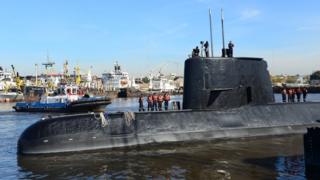
A search is under way for the ARA San Juan
A submarine with 44 crew on board remains missing after disappearing off the Argentine coast on Wednesday.
In the last reported contact with the ARA San Juan the sub's captain reported a breakdown relating to a "short circuit" in the sub's batteries.
Why can't subs be detected?
Submarines are built to be difficult to find. Their role is often to participate in secret surveillance operations.
Dr Robert Farley, a lecturer at the University of Kentucky who has written on the subject, says that a sub is very hard to trace if resting on the seabed because under such circumstances it will not be making any "noise".
"Noise, which would otherwise be picked up by what is known as passive sonar, is distorted and [the sub] looks - to active sonar pings - like the sea bottom," he says.
So how can subs be found?
There are a number of ways that the captain or crew can make their location known if in distress.
These methods include sending signal calls to contacts at naval bases or allied ships, or releasing a device that floats to the surface but remains attached to the submarine.
How long can a crew survive submerged?
The number of days that a crew can survive depends on how long they have already been performing duties underwater and how well prepared they are for losing power.
"If batteries were charged and air refreshed," Dr Farley says, "then outlook is hopeful".
In relation to the Argentine sub he adds: "Outer range appears to be ten days if they were well prepared."
- Missing sub 'reported breakdown'
How is the crew trained for this?
One of the most important practices is for trapped crew members to slow down their breathing rates in order to conserve oxygen.
Dr Farley says that this it is a hard thing to train people to do, adding that in such circumstances: "My guess is that they would be cautioned to reduce activity and reduce speaking in order to save oxygen."
Image copyright
Daniel Moreno/US Southern Command
An underwater rescue model has been deployed in the hunt for the missing Argentine vessel
The conditions, likely to be cold and damp, may well have a detrimental impact on morale, but the personnel on board will be well trained and disciplined.
They will likely establish routines, making themselves as comfortable as possible while minimising their movements and supporting one another as they await rescue.
What could have gone wrong?
This remains unclear in the case of the missing ARA San Juan.
But, says Dr Farley, it is possible that an electrical malfunction may have occurred following reports of a fault affecting the sub's batteries.
Such a breakdown could shut down both the engines and the communication system, he says.
- A look at subs of the future
Is there a plan for such accidents?
In the event that a submerged vessel suffers problems in returning to the surface, procedures can be implemented to help raise it.
To control buoyancy, the fuel or ballast tanks - which can add weight - can be emptied and used to lift the sub. To achieve this, the diesel fuel or ballast is released, emptying the tanks, and the chambers are then filled with air.
Subs also have small hydroplanes; wings that are adjusted to allow water to travel in different directions as the vessel pitches its bow and stern up or down to assist its movement.
What are the main dangers?
With a possible shortage of oxygen and a build-up of carbon monoxide, suffocation is the number one risk.
Oxygen can be supplied either through canisters or generators that perform a process called "electrolysis" - which effectively separates components such as water and oxygen. However a lack of power will hinder this process and the supply may gradually run out.
There are other dangers that could also come into play.
Dr Farley points out that if a compartment within a trapped sub becomes flooded, this can lead to "flash fires and other nastiness" as the air gets further compressed.
Built in Germany: 1983
Length: 66 metres
Crew: 44
Top speed: 45 km/h
Range: 22,224 km
Reuters
